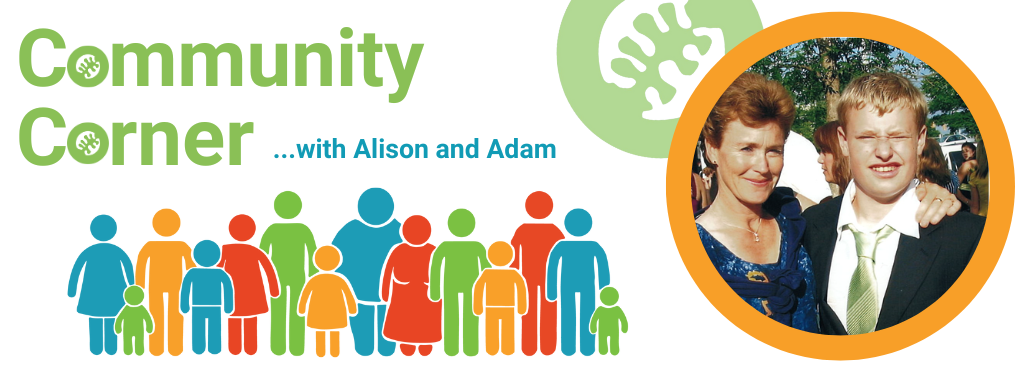
Community Corner with Alison and Adam
Adam’s Story
It’s been 29 years now, and nobody could have predicted how life would unfold. We were two healthy parents, and my daughter Lara was a healthy little girl. And then my son Adam arrived.
He, too, seemed to be a happy and thriving baby, hitting all his milestones. But around his first birthday, I started to notice some concerning signs. Adam lost weight, and every time I breastfed him, he vomited. When he started walking, he seemed to regain some strength – but it wasn’t long before new signs emerged. By the time Adam was three, he was showing signs of dystonia – a movement disorder that causes muscles to contract.
I started documenting things. We bought a video camera so I could record his episodes. I remember showing the videos to a neurologist, who said that Adam was a healthy boy. But soon after, Adam’s body started shutting down. He’d been showing more and more signs of lethargy, and when he was three years old we took him to SickKids, where he was admitted immediately.
After months of testing – including an invasive procedure where they took a muscle tissue sample from Adam’s leg to grow cells for analysis – he was diagnosed with Leigh syndrome, a rare and progressive mitochondrial disease. It was all pretty scary, but I did what I had to do as a mom.
Doctors recommended a variety of supplements including vitamins B1, B12, C, and CoQ10, as well as a high-fat, low-carb diet. We added more chicken, eggs, cheese, and sour cream to his diet. Everywhere we went, we took crushed vitamins in pots with yogurt. To this day, Adam doesn’t like yogurt.
Adam is so much more than his diagnosis. We tried to keep his childhood as normal as possible. He grew up playing on a baseball team and taking karate lessons. I’ll never forget watching him earn his yellow belt when he was six or seven years old. He remembered his entire routine and I was so proud of him. No one could tell that he was sick in that moment. No one could see his disability.
Adam is 29 now, and he’s an independent young man. He cooks and shops for himself, and loves nature walks and bike rides. His father is a tree farmer and for a time, Adam worked with him on the farm – a connection to the outdoors that he still enjoys. Adam’s looking for a new job now – something meaningful. Like many people with disabilities, motivation and connection are key. He thrives when surrounded by people who listen, acknowledge, and encourage him.
Adam still struggles sometimes. He recently had an MRI that showed lesions on the speech part of his brain, which explains why he stutters when he feels awkward or stressed. He’s been through a lot – more than most – yet he faces each day with quiet determination. He’s still moving forward and finding his way in life.
I wish we understood the body’s complexities more. In a way, we all have a malfunction – some are just more visible than others.
Adam once wrote in a note that we’re all here for a purpose and we need each other. That’s what made me want to share my story. Writing, sharing, leaning on each other – it all helps.


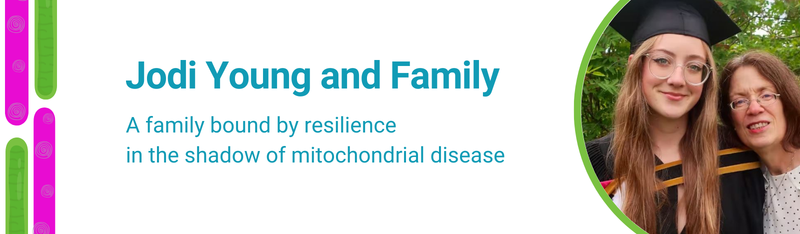
 The sisters and their family had never even heard of mitochondrial disease (mito) — and neither had many of the health care practitioners in their hometown of Newfoundland and Labrador, which contributed to the long path to diagnosis.
 While Jodi, Erika and their mother, Brenda, all have MELAS, the three of them are affected in different ways.
 Despite — or perhaps because of — these challenges, the Young family has developed a rare closeness. “My sister, mom, dad, and I will always have an unspoken bond that comes with experiencing mito,” says Erika. “Mito has definitely brought us all closer together,” agrees Jodi. “Dealing with mito can be extremely isolating, especially here in Newfoundland where there are few resources for anything, let alone a rare disease. This forced us to be closer, because we only had each other.”
 As they build their own rich lives as young adults — Jodi is a mitoScholar who’s passionate about entomology(the study of insects) and who’s currently pursuing a PhD in plant-pollinator interactions, and a huge animal lover who finds joy in spending time with her partner and her pets (a dog, birds, sugar gliders, and a snake), while Erika is a soil researcher who loves travelling and partaking in outdoor activities with her spouse and her Australian Shepherd — the sisters remain ever-committed to their parents. “While I no longer live at home, I see my parents almost every day,” says Erika. “The negative consequences of MELAS are ever-present even though I live a full life and am not actively experiencing symptoms of the disease.”